
News ·
Why you set your own pace in our biathlon
Our first biathlon asked you to tap to a beat. Playtests said it did not work. Here is what replaced it, and how we checked the new design is a real choice.
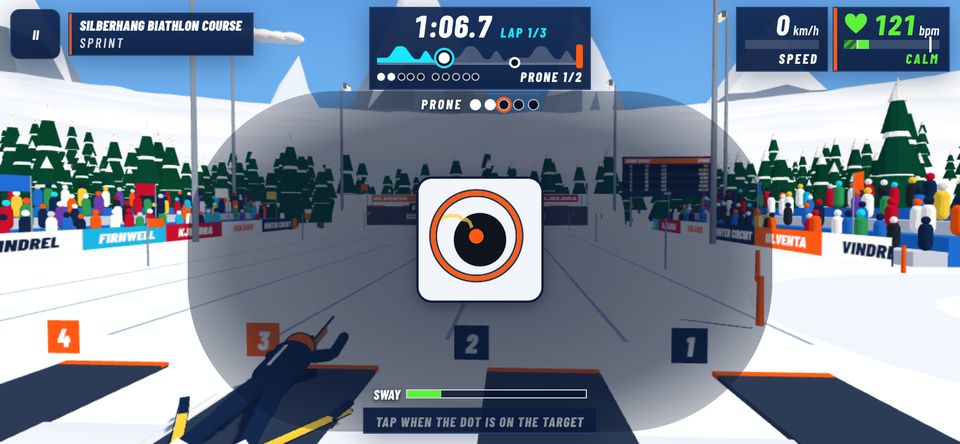
Biathlon is cross-country skiing and shooting in one race. What makes it interesting is the link between them. Ski hard and you gain time on the track, but you arrive at the range with a racing heart and a rifle that will not hold still. We wanted that choice in your hands. Our first attempt got it wrong.
The first version: keep the beat
In the first playable biathlon, every tap was a stride, and the game judged how even your strides were. A ring closed on each thumb pad, a bar showed your rhythm, and words told you how you did: perfect, good, off the beat. An even rhythm pushed harder, and the glide on the flat only worked with strides on the beat.
The first playtest was clear about it. The indicators sat right under your thumbs, so you never actually saw them while you were tapping. You were following a beat you could not see, and it did not feel like skiing. It felt like a rhythm game bolted onto a race.
The new version: you choose the pace
So the beat went, completely. Now a stride's push depends on how long it has been since your last tap and on the slope under your skis. Nothing judges how even your taps are. You still alternate thumbs, left and right, each on its own side of the screen, because that is how skating on skis feels.
How fast you tap is now the whole control, and it is a trade:
- Top speed. Tap quickly enough and you reach top speed, and your heart rate climbs fastest.
- Faster than that adds no speed at all. It only costs heart rate. Flailing does not help.
- A little slower is the economy pace: it uses the fewest heartbeats for every metre. This is where a well-paced race is skied.
The exact settings may still move after more playtests. The shape of the trade is what matters: a sweet spot a little below the top.
To make the trade visible, the game shows two bars side by side. The speed bar has a mark for the speed that top pace would give you on this stretch of the course, so you can see how much is left on the table without looking at your thumbs. The heart-rate bar has a red line, the point where your legs start to fade. Staying under it is your job.
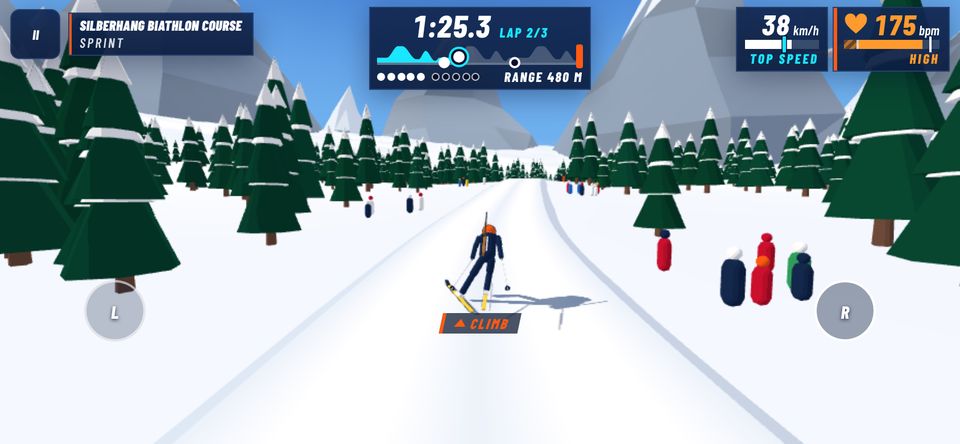
A side effect we liked: you tap far less than before, so a race is something you play, not a test of how long your thumbs last.
Making the red line mean something
Then we checked whether the choice was real. We ran different pacing plans through the simulation, each driven by the same pilot so only the plan differed: steady at race pace, steady at top speed, just under the red line, a hard last lap, an all-out first lap.
The results showed a problem. In Realistic, skiing at top speed the whole way still beat relaxed race-pace skiing. And fatigue, which is meant to punish you for living over the red line, barely moved: even the hardest skier finished nowhere near tired. Nobody would ever see it.
We changed two things. Fatigue now starts exactly at the red line the bar shows, and it builds quickly once you are over it instead of creeping up over the whole race. After that:
- Skiing at top speed all race now ends about twenty seconds slower over a Sprint than pacing just under the line.
- A skier who goes hot from the start sees the line move in by the end of the first lap, and is well over halfway to full fatigue by the finish.
- A skier who stays under the line builds no fatigue at all.
- A hard last lap, when you still have something left, still gains a little time. A late burst can pay; a whole race over the line does not.
In Arcade none of this applies: the heart rate stays easy and there is no fatigue, so you can enjoy the skiing and the shooting without the bookkeeping.
What players said
In the next playtest the verdict was what we hoped for: the biathlon felt better balanced, and finding the right pace was fun. That is the game we wanted. Not a beat to follow, but a decision to make, lap after lap: how much do you spend now, and what will it cost you at the range?