
Biathlon
You ski at a pace you choose, watch your heart rate against the red line, then settle the sight at the range and fire. Every miss is a penalty loop that you ski yourself.
Coming soon to iPhone and iPad
On the skis
There is no beat. You set the pace.
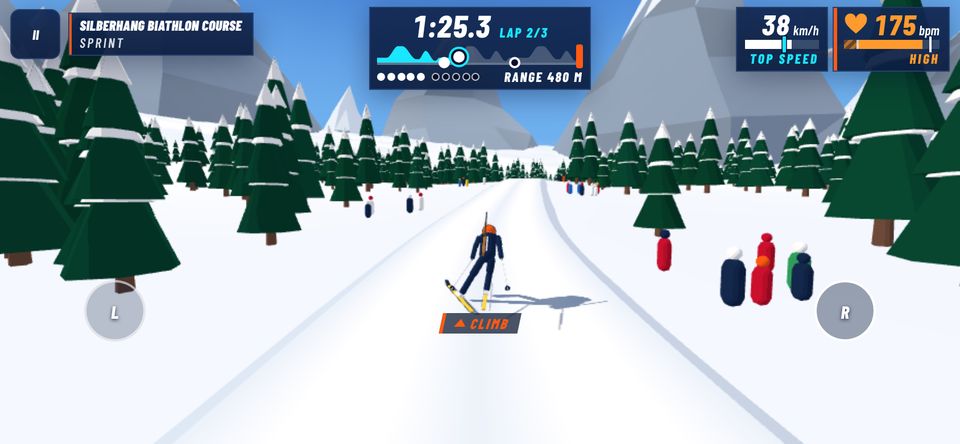
Tap left and right in turn: every tap is a stride, and how fast you tap is how hard you ski. Faster is quicker and costs heart rate. A little below top speed there is a race pace that costs the fewest heartbeats for every metre, and that is where a good race is skied. Tapping faster than top speed adds nothing but cost.
Two bars in the corner show the trade. The speed bar has a mark for top speed on this stretch, so you can see how much is left on the table. The heart-rate bar has a red line: staying under it is your job.
Climbs slow you down, and on the descents you stop tapping and tuck.
Realistic
Cross the red line and it stays with you
In Realistic, skiing over the red line builds fatigue. You see it on the heart-rate bar: the floor rises and the red line moves in, so the same effort takes you over it sooner, and your strides push less, lap after lap. A short burst can still pay, a whole race over the line does not. Arcade keeps your heart rate easy and has no fatigue at all.
- Pace under the lineNo fatigue at all. Your legs are as fresh on the last lap as on the first.
- A hard last lapWorth it when you have something left: a burst over the line at the end can still win time.
- Hot from the startThe line moves in within a lap or two, and the range gets harder with a racing heart.
At the range
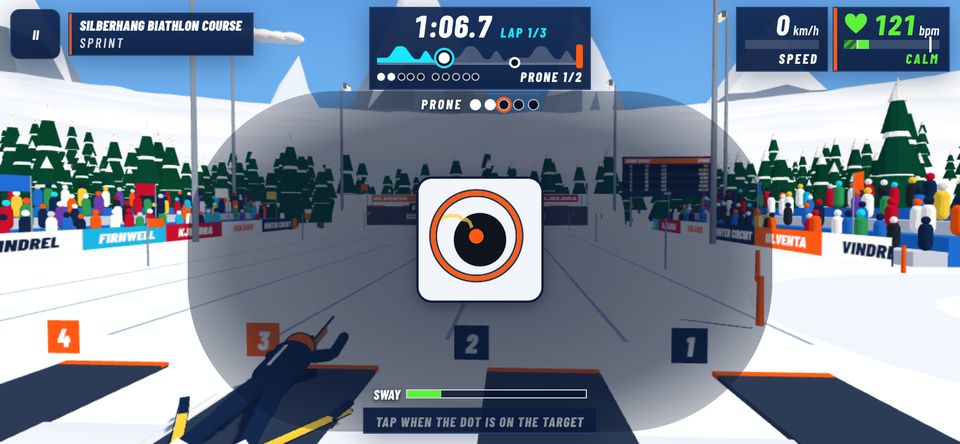
Fire when the sight settles
Glide into the range under control. The sight drifts in a slow figure of eight, and the higher your heart rate, the wider it swings and the more it shakes. Tap when the dot is on the target. Five targets, prone or standing, and every miss sends you round the penalty loop.
Rushing costs misses, waiting costs time: the range is where a race is won or lost.
- Free: Silberhang Biathlon Course
Sprint
Three laps, a prone and a standing shooting. Every miss is a penalty loop to ski. Your fastest time is your best.
- With the unlock
Individual
Five laps and four shootings: prone, standing, prone, standing. The long race, where pacing matters most.
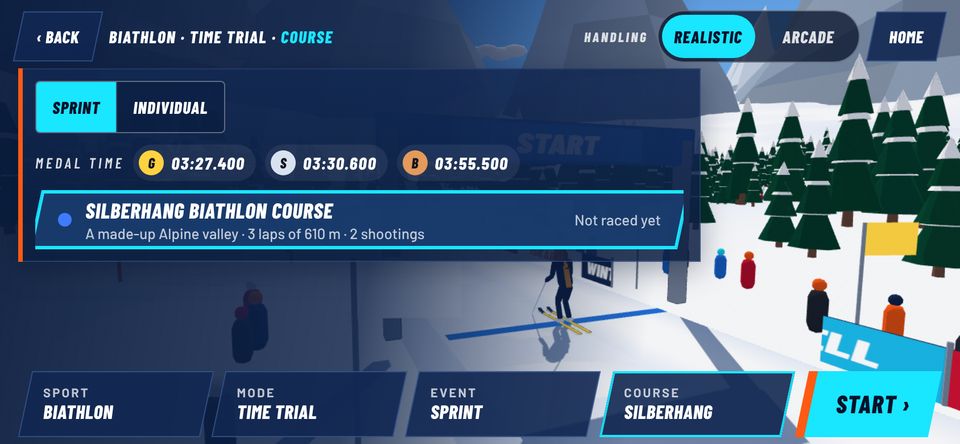
Choosing the race: Sprint or Individual, Realistic or Arcade.
Questions
Biathlon questions
Do I have to tap in time to a beat?
No. There is no rhythm to keep and no beat to hit. You choose how fast to tap, and that is how fast you ski. Alternate your thumbs, left and right, like strides.
What does the red line on the heart-rate bar mean?
It is where your legs start to fade. Stay under it and you can keep going. In Realistic, time spent over it builds fatigue that moves the line in and slows your strides for the rest of the race.
What happens when I miss a target?
You ski a penalty loop for each miss, right after the shooting. It costs a few seconds each time, so a steady hand is worth a lot.
What is in the free demo?
The Sprint is free, in both Arcade and Realistic, as often as you like. The Individual comes with the one-time unlock.